Isle of Wight - seeking sanctuary World War Two
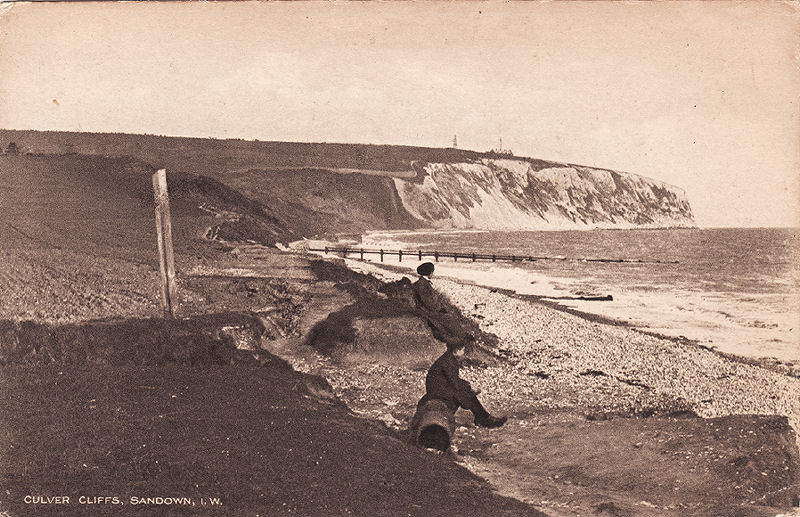
The next episode from my father's wartime journal covering his thoughts on Bomber Command aircrew training during 1941. This day he reminisces about his home, the Isle of Wight, with vivid, literary images of vantage points that I can readily place as I, too, explored the same places of my birthplace just over a decade later. Previous posts from the journal:
- World War Two aircrew training day one
- World War Two aircrew training day two
- World War Two aircrew training day six
- Wellington Bomber raid October 1941
Entry 3 - January 9th
At the moment I am about to go up on my first night flight. Today has been very fine, for January, and the night augurs well for the trip as the moon is already up delineated against the clear, cloudless, frosty sky. We went up this morning, as well, for a 3 hour cross country so today I shall feel I'm a real airman.
The long sojourns in the crew room today were broken up by thinking of the Isle of Wight. The saying that 'absence makes the heart grow fonder' is all too true as far as I am concerned with the Island. For too long I had been abusing it, disdaining it, now, at last, the memory of the home town recurs to me like a vision of paradise (Dad lived in Lake, a village between Sandown and Shanklin).
So vivid are these impressions, culled from the all too short periods of leave, that by now I can smell the tang of the salt laden, sea-weedy air that impinges on the back of the nostrils and permeates the system like a draught of nectar. I can feel the ridges on my arm as I lean over the guard wires on the cliff and stare happily at the slight, oily swell and the tumbling frothy tide breaking spasmodically on the brown sands below.
Away on the left is the symmetrical curved hump of Culver Cliffs, its regularity broken only by the outline of the fort and the wireless station with its aerial and obelisk. It sweeps up and over and ends in the sheer white cliffs which tumble into the sea. The white cliffs end suddenly and emerge as another strata of red sandstone which throws the whole setting into a remarkable relief. Just below us stands the pier with its pathetic broken back, the remnants of which are revealed by the ebbing tide. The whole scene is remarkable by its throbbing quiet broken only by the screech of a seagull or the shuffling gait of an aged couple taking a constitution which has become a ritual to them.
Yet again, superimposed on that vision, I find myself spirited away to the opposite end of the Bay where, sitting on the handrails of the steps on the cliff, I pause to stare at the wrinkled face of Dunnose Head. This old, red-brown cliff has its upper face worn and lined with the marks of denudation its lower part is worn smooth by the erosion of the sea. It stands impassively, brooding, looking out at the ocean, the changeless, yet changing, face of nature. Tufts of grass and clumps of gorse have precariously established themselves, where possible, on the cliff and give a personality unique to itself. A sea breeze ruffles the foliage of the trees beyond it and as I feel its chilling effect I shiver and learn how puny man is when faced with nature. How the grandeur of nature makes man's foolish plans and schemes pall into appalling insignificance?
The scene is changed once again, the air persistent in its claim for recognition has been subtly infusing with its salty tang the soft, sweet fragrance of the country meadows of hay, clover, gorse and trees. The sound of the quiet has changed from the rhythmic lap-lap of the gentle waves to the whistle of the wind in the trees and the passing of a breeze over a full stocked field. I'm looking from the road over the countryside. From the road the terrain rushes precipitously away to the bottom of a valley where a small stream meanders slowly to its ultimate end. A small copse covers the stream's retreat, a bastard offspring of a large wood, distant and barely seen. Beyond, the valley undulates gently up to a height slightly less than my vantage point, diversified by little nooks and rills characterised by the rambling hedges.
The more I contemplated, the more vivid the constantly changing vista becomes. How little I realised, for two years, the true value of those things I then considered commonplace and mundane. Once again that marvellous wonder of nature, the mind, rescues us and restores that beautiful environment.
Douglas George Banks 1920 – 1989 written in 1941
P
Aircrew training day two - politics

- World War Two aircrew training day one
- Wellington Bomber raid October 1941
- World War Two aircrew training day six
Entry 2 - January 8th
The snow is now being conquered by the thaw, but there is probably more on the way. Flying was cancelled today and so there were plenty of opportunities for soliloquising but I'm afraid I didn't feel up to calm deliberation. Still, as Johnny is forcing me to keep up my promise I must, at least, attempt something before he switches out the lights.
I have been arguing tonight on our new world which we are so hopefully promised by our over optimistic M.P.s after the successful conclusion of this present war. To me it seems we have yet to obtain a real grip on the problem. There will be such a vast potential of promise of better things to come that our usual vacillating policy will, in the end, achieve little, or no, good. We shall have to cast all party or sectarian principles aside and strive to obtain the best out of every one of our legislative officials. The ingrown prejudices of maturer years will have to be thrown aside and youth allowed to slip in and command.
All bias against our present enemies must be overthrown and we must co-operate wholeheartedly, both nationally and internationally, to restore and reconstruct the damage that the war has forced on the people. This revival must inevitably be essentially both of a spiritual and material nature. We must appeal to the people's better nature to allow certain powers to enable us to allow this reconstruction and, at the same time, place them in such a state of mind so that they will be able to benefit by such reforms as we will be able to give. Everything and everyone that stands in our way in our path to a fuller life must be swept aside so that nothing can impede the inevitable and irresistible path of progress.
It is also essential for us to deal with fundamental realities so that at the moment we can evolve no theory or ideal is to take its place at the head of affairs. We can work on no fixed plan but will have to deal with the situation in which we find ourselves. As soon as the war ends we can start; a co-ordinated body of youth determined, at last, to give the world a new light to guide them, not disdaining criticism, but determined that nothing can deter them from reaching their goal.
Douglas George Banks 1920 – 1989 written in 1941

Subscribe to:
Posts (Atom)


